Dogs
Earth AbidesDogs survive the collapse of human society by changing from dependent companions into scavengers, predators, descendants of Princess, and finally working partners in a new community. Their shifting fortunes make them more than signs of the vanished human world: they respond to hunger, competition, and new patterns of settlement, sometimes thriving beyond human control and sometimes becoming vulnerable to the very ecological changes they helped shape.
From domestic animals to survivors
In the first days after the collapse, dogs face the sudden loss of the people and routines on which many had depended. Animals confined in kennels die of thirst, while those able to roam search for water and food in streams, fountains, and ponds. Some hunt or scavenge; others approach the bodies of the dead as hunger overtakes the habits formed during generations of domestication. The contrast is stark: freedom gives some dogs a chance to survive, but it offers no guarantee that they can find food or adapt.
The old distinctions between valuable breeds and unwanted mongrels lose their force. In the new conditions, survival depends less on pedigree or appearance than on alertness, strength, and the ability to meet unfamiliar demands. Individual dogs illustrate the unevenness of that change. Peaches, a honey-colored spaniel, cannot find food through hunting or craft and grows weaker. Spot, a children's mongrel, survives by finding a litter of kittens and eating them. Ned, a terrier accustomed to roaming alone, fares comparatively well. Bridget, a red setter, is described as unable to find purpose in a world without a master or mistress. Their varied outcomes make adaptation a matter of circumstance and disposition, not a simple triumph of the strongest breed.
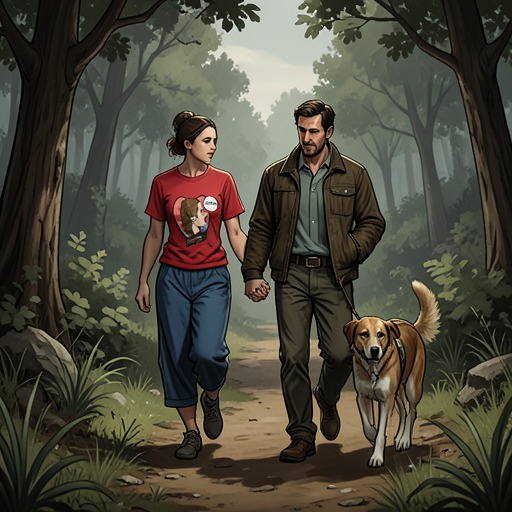
Ish encounters this altered world before he takes in Princess. While loading his station wagon, he notices a small, long-eared, white-and-liver dog standing about ten feet away. He has seen many dogs, including animals that appear starved or unusually well fed, fearful or aggressive, and has tried not to dwell on their plight. This dog watches him, wags its tail, and whimpers quietly. The meeting begins at a distance, with the dog neither already domesticated by Ish nor immediately treated as a possession; it approaches him cautiously and elicits his attention amid the larger work of survival.
Princess and the changing animal landscape
The dog Ish takes in becomes Princess, but her later life is not one of uninterrupted safety or dependence. She disappears for a day or two on various occasions, apparently meeting other dogs, and the number of dogs around the community eventually grows into the dozens. The narrative identifies many of them as her children, grandchildren, or great-grandchildren. Her companionship with Ish thus has an ecological consequence: the rescued individual becomes the ancestor of a local population.
Dogs also reorganize their behavior in response to other animals and to the supplies left behind. In parts of the city, especially near the waterfront, Ish sees small, active terriers and terrier-like mongrels. They feed on supplies in stores, sometimes following rats that have opened cartons of crackers, and also appear to prey on rats. Their concentration in places where rats had been common suggests a new food relationship shaped by the ruined city rather than by human ownership. Later, Ish watches a different hunting pack: ten dogs of varied kinds, including a Great Dane, a collie, and a spotted Dalmatian, all relatively long-legged and powerful. They have assembled without human direction and are already acting together as hunters.
Princess, meanwhile, is no uniformly fearless predator. When she returns from an excursion and encounters a goat, she barks at it, but the goat lowers its horns and charges. She uses a quick, rabbit-like dodge and runs back to Ish; the goat resumes eating. The small episode emphasizes that animal encounters are not reducible to a stable hierarchy between hunter and prey. Princess can alarm another animal, yet she also judges danger and retreats, while the goat remains focused on feeding.
Rats, risk, and retreat
The rise of the rats reverses the dogs’ earlier advantage. Ish reasons that, with people gone and food abundant, rat numbers could increase rapidly. Before the collapse, people had been the principal force keeping city rats under control; afterward, dogs and cats were among the few remaining predators. But rat-catching dogs appear to have driven off or killed cats as well as catching rats, removing another check on the rodents. Ish concludes that the rats eventually overwhelmed the dogs, which may have withdrawn to the suburbs rather than being entirely wiped out. The once-visible dogs vanish from the city as the balance of power changes.
A small dog’s skull, found near a wall, gives Ish a particular reason to take the danger seriously. Its long teeth suggest it was probably a terrier, and its position makes him think it may have been cornered there while fighting. He imagines the way a swarm could attack from several directions until the dog could no longer defend itself. The encounter turns an ecological inference into a practical concern: Ish decides to watch Princess more carefully. He keeps her mostly inside, although the rats have not attacked her, and later arranges for her to go out only once a day.
That precaution becomes urgent when Princess returns from one of those daily outings howling, with rats skirmishing around her and several clinging to her. Ish and his companions believe they have killed the rats involved, but afterward keep Princess indoors and muzzle her because they fear hydrophobia. They also observe rats pursuing and attacking one another, sometimes in groups, and judge that the rodents seem less numerous, although they cannot tell whether the change is real or whether the rats have become less visible. Dogs are therefore affected by the crisis in several ways: they once prey on rats, are later displaced by their growing numbers, and can still be exposed to the danger when they venture outside.
From companion animals to working partners
As the surviving community develops, dogs acquire a practical role as well as a domestic one. Ish, still limited in long walks after being mauled by a mountain lion, and George, whose legs are stiff with age, rely on dog teams for transportation. The teams draw small wagons. Dogs require comparatively little care and can be fed less choice cuts of the many cattle available nearby. Horses would need good pasture and protection from wolves and lions, making them a less suitable option for the community’s modest needs. George takes pleasure in building the wagons and keeping them in repair.
The arrangement is not immediately comfortable for Ish. At first, riding behind four dogs in one of the wagons makes him feel ridiculous, as if he were part of a pageant. Years pass before he stops feeling that the sight is an absurd spectacle. The practical value gradually outweighs his embarrassment: automobiles have become difficult to keep running, while dog teams offer a workable means of moving people and goods. The dogs’ role changes with the community’s circumstances, from companions and scavengers to part of its transportation system.
Their training is visible in the routine of travel. Ish insists that a rifle be checked and carried as insurance against a troublesome bull or a bear with cubs, even though the chance of meeting either is small. When the teams set out, the dogs rush forward barking, the other teams follow, and boys yell alongside them; dogs near the houses answer the noise. At a stop, the boys tie up the teams, whose dogs lie down in orderly fashion without tangling the harness. On another departure, some dogs are released to run home by themselves, while the remaining teams are hitched together. The dogs’ behavior is energetic but sufficiently disciplined to make the wagons useful.
Dogs within a rebuilt community
Dogs also register the arrival of strangers in ways that connect them to, but do not make them identical with, human social judgment. When Charlie first joins the community, two house dogs nuzzle him. They are interested in his unfamiliar scent; initially neutral, they soon relax as he pulls their ears and scratches their backs. Their acceptance does not settle the community’s later conflict with Charlie, but the scene distinguishes the animals’ immediate response from the suspicion and deliberation that shape human decisions.
The dogs’ history is consequently a sequence of changing relations rather than a simple return to domestication. Some die when confinement and thirst cut them off from the resources they need; others survive by roaming, scavenging, or hunting. Princess forms a lasting bond with Ish and leaves a growing local lineage, while the rat population later alters which dogs can remain in the city. In the community, trained teams turn canine strength and cooperation toward travel. These changes give dogs independent weight in the novel’s post-collapse ecology: human beings continue to care for, feed, train, and fear them, but the animals’ own capacities and limits help determine how both species live in the transformed world.